The Unbearable Productivity of Doing Absolutely Nothing
There's a scene that plays out across American cities every weekend morning with the reliability of a religious ritual. A person — let's say late 20s, AirPods in, Stanley cup in hand — is on a walk. Not a casual, aimless walk. A walk. It's logged on an app. There's a playlist curated for it. Maybe a podcast about optimization is playing. The walk has a purpose: it is intentional movement, a non-negotiable in their routine. They will post about it later, or at minimum, count it toward a streak.
This is not leisure. This is labor wearing leisure's clothes.
And it is, at this point, so thoroughly normalized in American culture that pointing it out sounds almost offensive — like you're criticizing someone for being too healthy, too intentional, too committed to their own growth. But the thing that's been quietly swapped out here isn't a small thing. It's the entire concept of free time.
How Rest Got Rebranded
The transformation of leisure into productivity didn't happen overnight, and it didn't happen by accident. It happened through decades of gradual cultural messaging — from the Protestant work ethic to the Reagan-era glorification of hustle to the early 2000s self-help boom — that made the concept of unproductive time feel morally suspect.
But the current iteration is something new. It's not just that Americans work too much (though they do — the US has among the fewest legally mandated vacation days of any developed nation). It's that the cultural infrastructure has been built to ensure that the time not working is also optimized, tracked, improved upon, and ideally monetized.
The wellness industry, the self-help economy, the creator economy, and the fitness industry have all converged on the same territory: your downtime. Your evenings. Your weekends. Your Sunday mornings. All of it is now potential content, potential growth, potential income — and the messaging from every direction is that failing to treat it as such is a missed opportunity at best, a character flaw at worst.
The Subscription Model of Relaxation
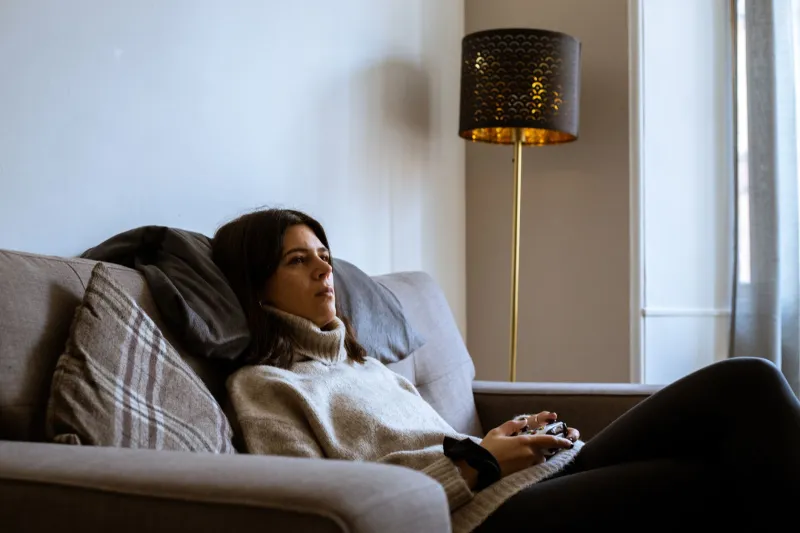
Consider what it now costs to do nothing. Actual nothing — lying on a couch, staring at the ceiling, letting your mind wander without direction or documentation — is free. It requires no equipment, no app, no subscription, no community.
And yet the industry has worked impressively hard to make it feel insufficient. Meditation requires Calm or Headspace ($70/year, minimum). Rest requires a sleep tracker. Reading requires Audible or Kindle Unlimited. Even breathing — actual breathing — has been repackaged as breathwork, complete with facilitators, retreats, and online courses ranging from $50 to several hundred dollars.
The most audacious example might be the proliferation of "do nothing" courses and "boredom retreats" — paid experiences that will teach you, for a fee, how to sit quietly. The irony is architectural. The industry that destroyed your capacity for stillness is now selling it back to you as a premium experience.
This isn't fringe content. "Digital detox" retreats in the US regularly charge $2,000 to $5,000 for a weekend. The market for mindfulness apps exceeded $2 billion in 2023. We have industrialized the antidote to industrialization.
The Content Imperative
Social media didn't just change how we share our leisure — it changed what leisure is. When an activity's value is partly determined by whether it's documentable and shareable, the activities that don't photograph well quietly disappear from the menu.
When's the last time you heard someone describe their weekend as "honestly pretty boring, just kind of hung around" without an apologetic qualifier? Boredom has become something to explain, to justify, to fix. The culturally acceptable weekend is full — full of experiences, brunches, workouts, events, projects, content. Fullness signals that you are someone with options, with community, with a life worth envying.
Empty time reads as failure. Or worse, as depression. We've pathologized the fallow period so completely that the natural human experience of simply not having much going on has become indistinguishable from crisis.
What We Actually Lose
This is where it stops being just a cultural observation and starts being a genuine concern. Research on creativity, mental health, and cognitive function consistently points to unstructured time as essential — not as a luxury, but as a biological and psychological necessity.
Boredom, specifically, has been shown to be a precursor to creative thinking. The wandering mind makes unexpected connections. It processes unresolved emotions. It generates the kind of novel ideas that focused, task-oriented attention can't produce. Psychologist Sandi Mann, who has studied boredom extensively, has argued that we've become so skilled at avoiding it that we've cut ourselves off from one of the brain's most productive states.
Beyond creativity, there's the simpler matter of what it feels like to live inside a life that has no empty spaces. The relentless optimization of downtime produces a specific kind of exhaustion that rest can't fix — because the rest itself has been turned into another task. You can't recover from performing productivity by performing recovery.
The Radical Act of Wasting Time
There's a version of this conversation that ends with a listicle: Five Ways to Reclaim Your Leisure Time. That would be its own kind of joke. So instead, consider this less a prescription and more a permission slip.
You are allowed to be bored. You are allowed to spend a Saturday afternoon doing something that produces no content, generates no income, improves no skill, and cannot be tracked by any app. You are allowed to have a hobby that is genuinely, stubbornly bad — one you do only because it passes the time in a way that feels okay.
The walk doesn't have to be intentional. The book doesn't have to be educational. The nap doesn't need to be optimized for sleep cycles. The weekend doesn't have to be evidence of a life well-curated.
American culture has spent decades building infrastructure to monetize every margin of your attention and every hour of your time. Opting out of that — actually, genuinely opting out, not in a way you'll post about later — might be the most countercultural thing you can do right now.
It won't cost you anything. Which is, at this point, almost revolutionary.